
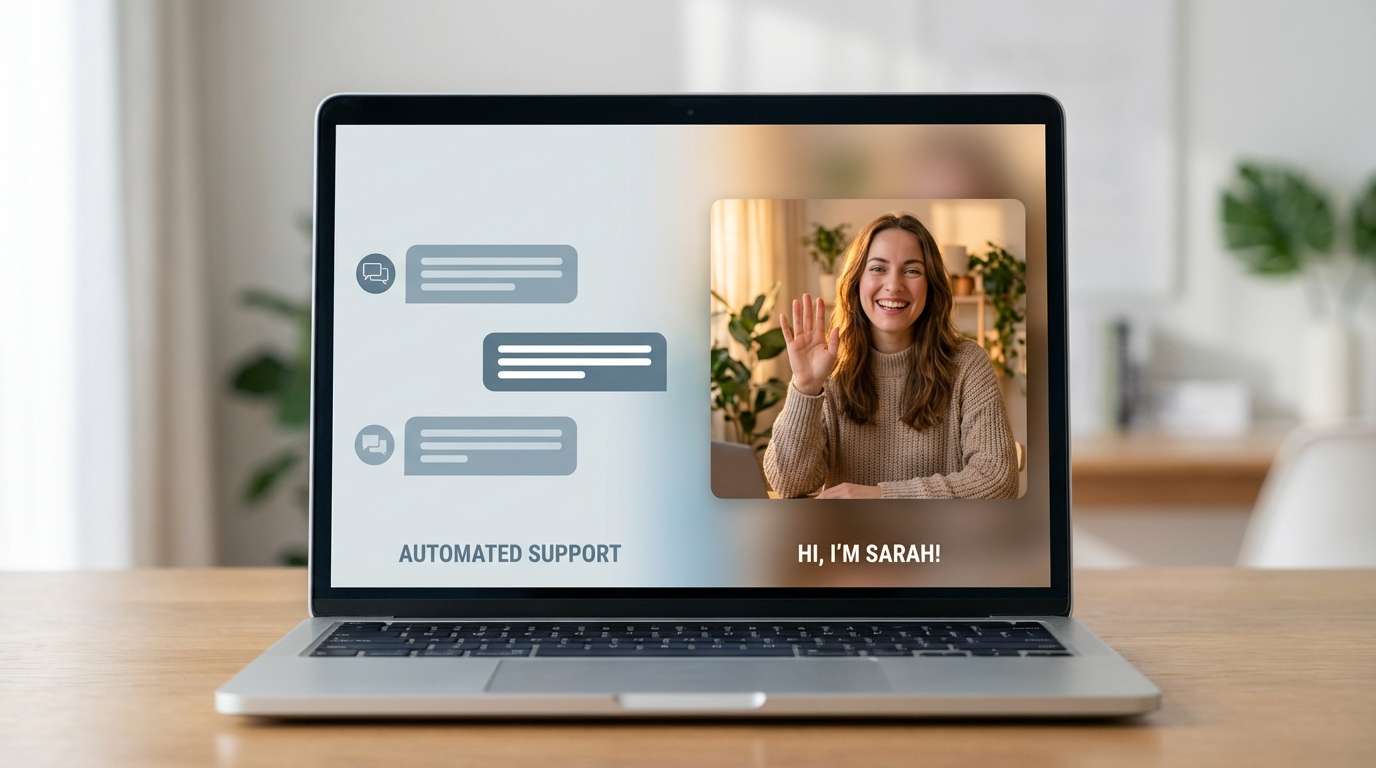
Your Customers Don’t Hate Chatbots — They Hate Not Being Able to Reach You
Why the Smartest Businesses in 2026 Are Using AI to Start Conversations, Not End Them
Your website chatbot is doing exactly what you asked it to do. It’s answering questions at 2 a.m. It’s handling order status requests, explaining your return policy, and greeting every visitor with a cheerful pop-up. And according to recent data, that’s precisely what your customers want — at least, for the simple stuff.
But here’s the part that should keep you up at night: the moment that chatbot can’t help, or the moment a visitor’s question carries any emotional weight at all, they don’t just get frustrated. They leave. And most of them never come back.
The 2026 customer experience landscape has delivered a verdict that surprises almost no one who runs a relationship-driven business: AI is brilliant at efficiency, but people still crave human connection. The brands thriving right now aren’t the ones who automated the most. They’re the ones who figured out how to use AI as a bridge to real, human conversation — not a wall that blocks it.
The Numbers Tell a Very Human Story
Let’s start with what the data actually says, because it’s more nuanced than the “AI vs. humans” headlines suggest.
According to Zendesk’s 2026 CX Trends Report, 54% of consumers would rather wait for a human agent than interact with a chatbot. Yet 69% will try a chatbot first for simple queries like checking an order status or finding store hours. Those two facts aren’t contradictory — they reveal exactly how people think about customer communication in 2026.
Customers don’t object to automation. They object to automation that traps them.
A February 2026 study by SurveyMonkey found that 79% of Americans strongly prefer interacting with a human over an AI agent. And the number climbs higher when the stakes do — when trust, empathy, or nuance is involved, people overwhelmingly want a real person on the other end. Only 8% of consumers prefer AI over a human for customer service, while 61% say human agents better understand their needs.
Meanwhile, 81% of consumers say they want the option to escalate to a human at any point in a chatbot conversation. Not eventually. Not after jumping through hoops. At any point.
The frustration is real, and it’s measurable. Nearly half of consumers — 46% — believe chatbots are deliberately deployed to prevent them from reaching a live person. Whether that’s the intention or not, it’s the perception. And in customer experience, perception is reality.
The Pendulum Is Swinging Back
Something deeper is happening in 2026 that goes beyond customer service metrics. There’s a cultural shift underway.
MarTech reported in early 2026 that 93.4% of U.S. consumers prefer interacting with a human over AI for customer service, according to research from OutreachX. The same study found that 88.8% believe companies should always offer the option to speak with a real person. Mike Donoghue, CEO of messaging platform Subtext, put it memorably: people want to talk through machines, not to machines.
CX Dive noted that more than four out of five consumers say they’re more likely to stay loyal to companies that prioritize human customer service over automated or self-service options alone. Nearly all respondents in the same survey agreed that brands investing in authentic human connection will have a long-term competitive advantage.
This isn’t anti-technology sentiment. It’s pro-human sentiment — and there’s a world of difference between the two.
Customers are telling us something profound: use AI to handle the repetitive stuff, absolutely. But when I have a real question, when I need reassurance about a purchase, when I want to know if your product is right for me — give me a human being. Give me a face. Give me a voice.
Where Most Businesses Get Stuck
Here’s the problem. Most small and medium businesses heard the “you need a chatbot” message loud and clear. They installed one. Maybe they even trained it on their FAQ content. But that’s where the investment stopped.
The chatbot handles the simple questions, and everything else falls into a void — an email form, a “we’ll get back to you in 24-48 hours” message, or worse, nothing at all. The customer who was ready to buy, ready to commit, ready to trust you just needed one more conversation. And your website offered them a dead end.
The businesses losing ground in 2026 aren’t the ones without AI. They’re the ones who deployed AI without building a bridge from that AI to a real human conversation.
Think about your own experience as a consumer. You visit a website for a service you’re considering. The chatbot answers your first couple of questions. But then you have a question that’s specific to your situation — something the chatbot can’t quite address. What do you want in that moment?
You want someone to look you in the eye (even virtually) and say, “Hey, hi! Tell me what you’re working with and let’s figure this out together.”
That five-minute conversation is where trust gets built. That’s where curiosity converts to confidence. That’s where a visitor becomes a customer, and a customer becomes a loyal advocate.
The AI-to-Human Handoff: A Smarter Model
The most forward-thinking businesses in 2026 have adopted what might be called the “AI-to-human” model. It works like this:
AI handles the front door. When a visitor lands on your site with a common question — pricing, hours, product specs, shipping policies — your AI-powered system delivers fast, accurate answers. No wait time. No friction. Customers appreciate this, and the data backs it up: 74% of consumers prefer chatbots for simple, quick queries.
AI then opens a second door. Instead of ending the interaction with a canned “Is there anything else I can help with?” response, the system actively invites the visitor to connect with a real person. Not buried in a submenu. Not behind three clicks. Right there, woven into the experience: “Want to talk this through with a real person? Grab 5 minutes face-to-face — it’s quick and easy.”
The human takes it from there. A brief, focused video chat. A quick message thread. An asynchronous conversation dashboard where both sides can exchange notes, questions, and follow-ups on their own schedule. The format fits the customer’s comfort level, and the conversation builds a relationship that no chatbot ever could.
This model respects the customer’s time and their humanity. It uses AI for what AI does best — speed and availability — and reserves human interaction for what humans do best — empathy, nuance, and trust.
Why Five Minutes Changes Everything
There’s a reason brief, focused interactions are so powerful. The psychology is straightforward: a five-minute video chat is low-commitment enough that people will actually do it, but long enough to establish genuine rapport.
Consider the difference between these two scenarios:
Scenario A: A potential customer visits your auto dealership website. The chatbot answers questions about a vehicle’s MPG and trim options. The visitor leaves with information but no emotional connection to your dealership. They continue shopping.
Scenario B: The same visitor gets the same chatbot answers, but then sees an invitation: “Want a quick video walkthrough of this model? Grab 5 minutes with our team.” They click, they connect, they see a friendly face who walks them through the vehicle and answers their specific questions. They feel known. They visit the lot that weekend.
The information was identical. The human connection made the sale.
This pattern repeats across industries. A luxury retailer who offers a quick personal styling consultation builds brand intimacy that no product page can match. A nutrition business that lets customers ask an expert about ingredients over video builds trust that drives repeat purchases. A professional services firm that puts a face to a name in a five-minute intro call accelerates relationships that might otherwise take weeks of email back-and-forth.
Privacy Matters More Than You Think
There’s another dimension to this conversation that most businesses overlook: privacy.
When a customer reaches out through traditional channels, they’re often forced to hand over their mobile phone number before they even know if the interaction will be worthwhile. It’s a trust barrier, and it’s a big one — especially for first-time visitors who aren’t yet sure they want a relationship with your brand.
The best communication platforms in 2026 respect this reality. They let customers engage through email-based notifications, keeping their phone numbers private until they choose to share more. It’s a small thing that signals something big: we value your comfort and your privacy.
In a year when 53% of consumers report being extremely or very concerned about the privacy of their personal information, this kind of design choice isn’t just thoughtful — it’s a competitive advantage.
What This Means for Your Business
If you’re a small or medium business owner reading this, here’s the honest takeaway: you probably don’t need to replace your chatbot. You need to build a bridge from it.
The data is overwhelming. Customers want AI for speed and simplicity. But they want humans for everything else — and “everything else” is where loyalty, trust, and revenue actually live.
The businesses winning in 2026 are the ones that make it effortless for a customer to go from an automated FAQ answer to a real face-to-face conversation in under 60 seconds. No complex scheduling. No phone number required. No software to download. Just a quick click, and suddenly your customer is looking at a real person who’s ready to help.
That’s the model behind 5minF2F — a platform purpose-built to bridge the gap between AI automation and authentic human connection. 5minF2F combines an AI-powered FAQ engine (that actively invites real human conversation with every response) with instant video chat requests, scheduled five-minute face-to-face sessions, and asynchronous conversation dashboards where you and your customers can exchange messages, files, audio, and video on your own schedules.
It’s all of your communication tools — scheduling, video chat, async messaging, AI FAQ handling, promotional assets, QR codes, and embeddable widgets — in one platform, for one simple price. No per-chat fees. No forced phone number sharing. Just genuine, human connection made easy.
Because in 2026, the businesses that win won’t be the ones with the smartest chatbot. They’ll be the ones who use that chatbot to say: “Hey, hi — let’s talk.”
Ready to turn your AI into a bridge, not a wall? Start your free 14-day trial of 5minF2F and give your customers the human connection they’re looking for — starting with just 5 minutes.
Sources: Zendesk CX Trends Report 2026, SurveyMonkey Consumer AI Sentiment Study (Q4 2025 / February 2026), MarTech, CX Dive, OutreachX, Salesforce, Intercom, CustomerThink, Merren 2026 Consumer Experience Trends Report.